Your 7-Day Trial Is Now Active.
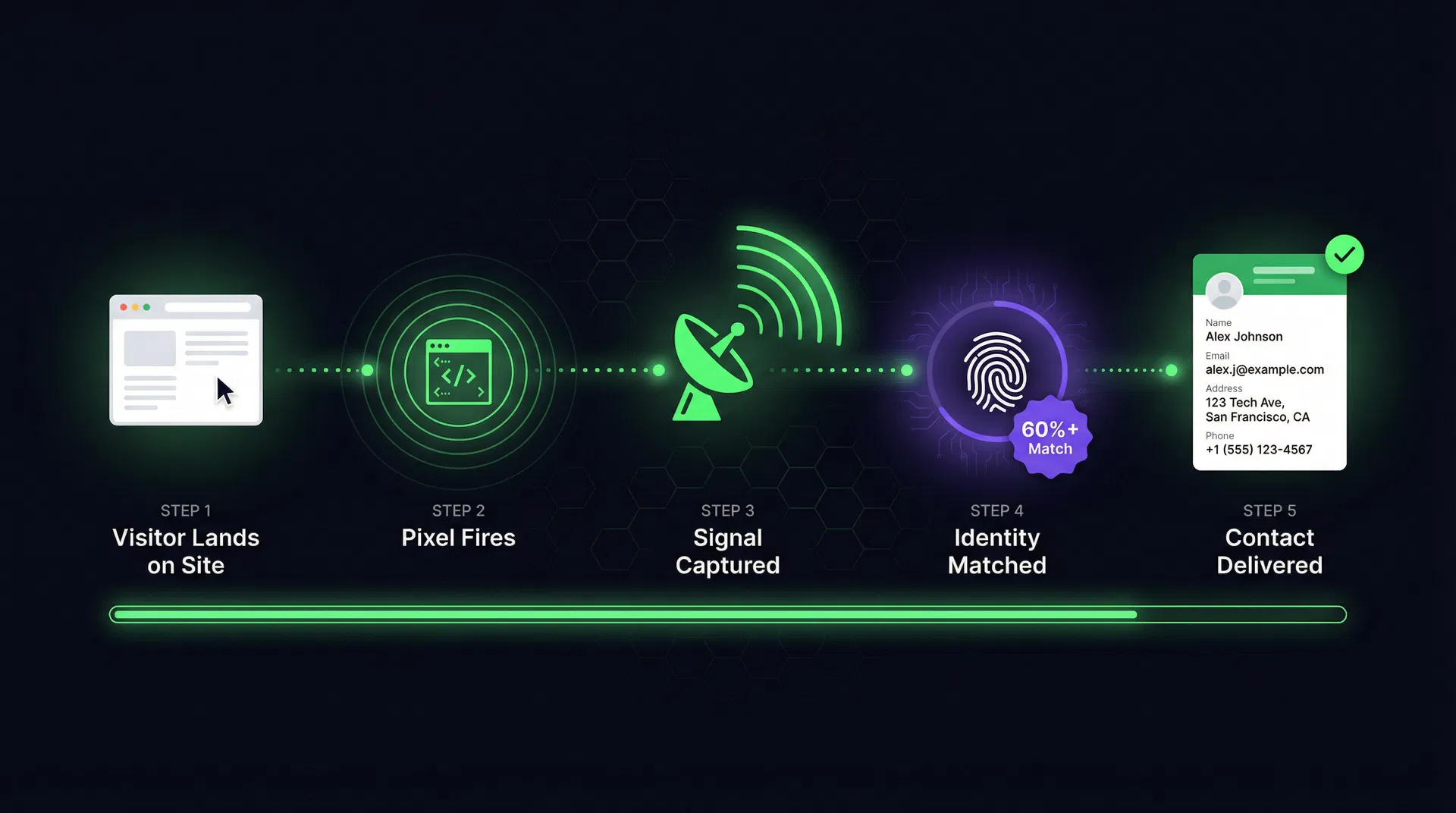
Your V4 Pixel is already identifying anonymous visitors on your website right now — matching them to real people with verified names, addresses, and contact information.
Before our next call, here's exactly how the pixel works — and how we can take things even further.
How V4 Actually Identifies People
Tap any card to go deeper into the technology behind your trial.
We Built Our Own Identity System
Most data companies buy their data from someone else and resell it. We built our own system from scratch — a private database of 308M+ Americans that we own, maintain, and verify ourselves.
Geoframe™ Resolution — We Know It's Actually You
When your pixel fires, we don't just log an IP. We cross-reference the visitor's current IP against their verified home IP and confirm their location using precise longitude and latitude coordinates.
30-Day NCOA Refresh — They Don't
We run our entire database of 308M+ records through the National Change of Address (NCOA) system — the U.S. Postal Service's official database — every 30 days.
Once We Find Someone, We Never Lose Them
You've heard that cookies are going away and tracking is getting harder. That doesn't affect us — because once we verify someone, we create a permanent UID2 identifier that follows them forever.
Why Other Pixels Can't Be Trusted
When a competitor claims 40–60% match rates, here's what's actually happening behind the numbers.
The Starbucks Problem
When someone visits your site from a shared WiFi — a café, office, or hotel — most pixels capture the IP address of the entire network. They report every person on that WiFi as a match. One real visitor becomes 10, 20, or 50 "matches." The numbers look great. The data is useless.
1 real visitor → reported as 50 "matches"
The Stale Data Problem
Over 40 million Americans move every year — more than 11% of the population. Most data companies refresh their address databases every 3 months to 3 years. That means the "match" they give you is pointing to someone who moved out months ago. The data costs over $260,000/month to keep current. Most companies simply don't pay it.
Industry refresh rate: every 3 months – 3 years

V4 Pixel vs. Industry Standard
| Metric | V4 Pixel | Industry Average |
|---|---|---|
| Match verification method | Geoframe™ — individual confirmed | IP address only (shared network) |
| Database size | 308M+ consumer records | Varies, often resold data |
| Address refresh frequency | Every 30 days (NCOA) | Every 3 months – 3 years |
| True match accuracy | 60%+ verified | Inflated — includes network noise |
| UID2 integration | Yes — 8B+ mappings | Rarely |
| Cost to maintain data freshness | $260,000+/month | Not invested |
What If We Could Send Them To You First?
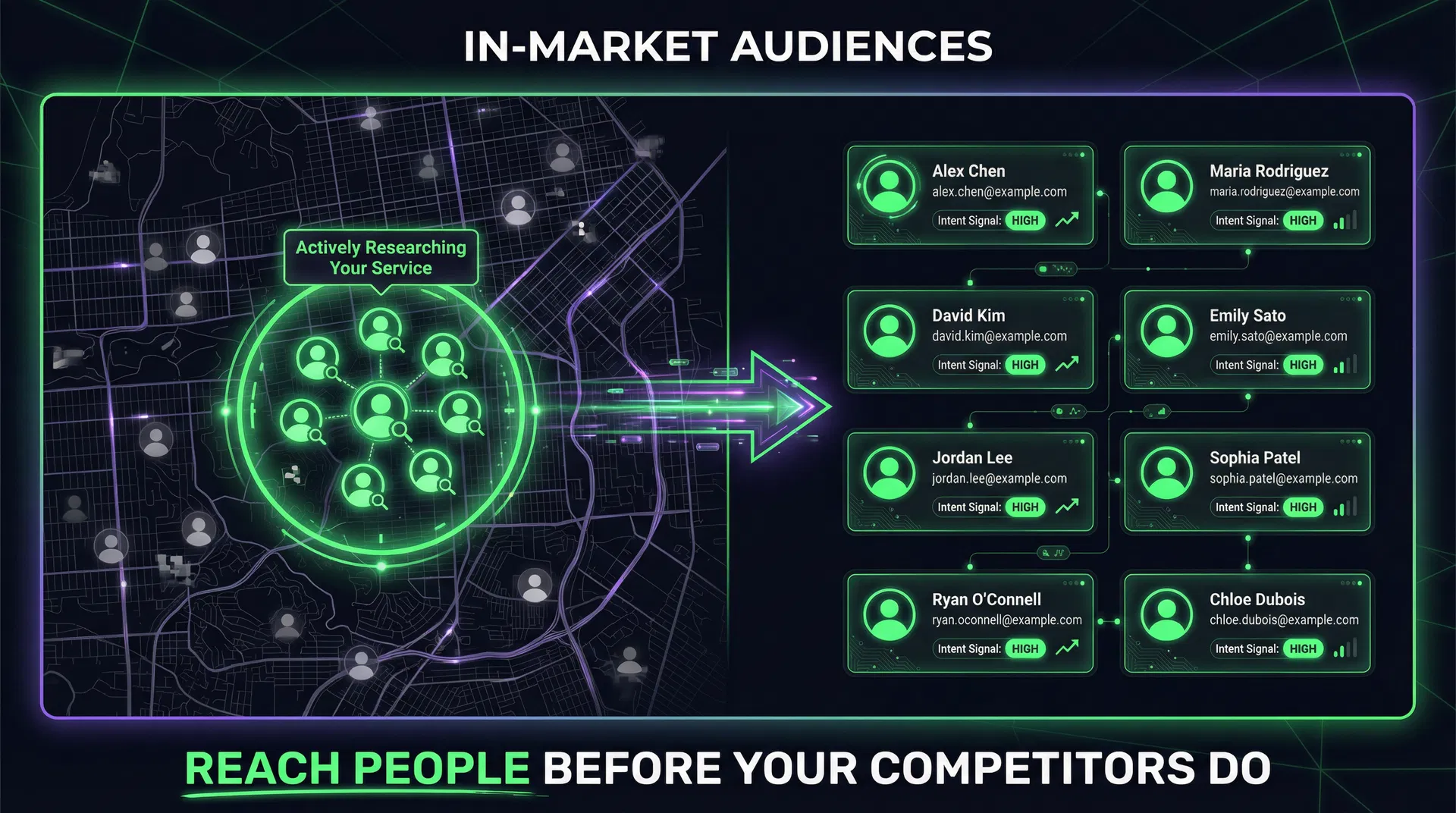
Your pixel identifies the people already coming to your website. But there's another side to AudienceLab — targeting people who are already looking for your service, before they ever find you.
Imagine you run a business. Right now, you're running ads hoping the right person sees them. Most of your budget goes to people who aren't even thinking about buying.
Now imagine someone hands you a list of every person in your area who has been actively researching your type of service this week — with their name, email, and address, and target them right as they become in the market for your service.
That's what AudienceLab does.
We See Who's Shopping
We monitor browsing behavior across 3.7 million partner websites. When someone in your market starts actively researching what you sell, we pick up that signal in real time.
We Verify They're Real
Unlike other companies that guess, we confirm the identity against multiple sources — name, email, address — all checked and updated every 30 days. No stale data. No inflated lists.
You Reach Them Directly
Run targeted ads on Facebook, Google, or TikTok. Send an email. Mail a postcard. Call them. It's your data — use it on any platform, any way you want.
Why This Changes Everything
- ✕Running ads and hoping the right person sees them
- ✕Someone visits your site and you never know who they were
- ✕Targeting by age, location, and interests
- ✕Ad budget spread across thousands of random people
- ✕Building audiences inside Facebook — they own the data
- Start with a list of people already looking for what you sell
- Know exactly who visited — name, email, what they looked at
- Target people based on what they're actively researching right now
- Every dollar going to someone already in-market
- You own your audience data — use it on any platform, forever
These two work in combination. The pixel captures and converts the traffic you already have. In-market audiences bring you more of the right traffic in the first place.
Businesses Just Like Yours Are Seeing It Work
Different industries, different sizes — same result: they stopped wasting money on the wrong people.
$471K in annuities from a single audience
Used AudienceLab to find people actively researching annuities and final expense products — verified, in-market, right now.
1,608 leads in 3 days from existing website traffic
Identified who their website visitors were and matched them to real contact information — filtered by vehicle interest and credit profile.
VSL opt-in cost dropped 50% in 24 hours
Uploaded pixel data to ad campaigns. Within 24 hours, costs were cut in half — same creative, same budget, just better data.
27 sales of ~$10K over one weekend
Built a lookalike audience using AudienceLab data. 27 sales at approximately $10,000 each, with cost-per-acquisition dropping 40%.
$30K return from a $2,500 list
Purchased a targeted list of homeowners actively searching for roofing services in the last 24–48 hours. Nearly instant return.
27 conversions in 6 days from under $100 spend
Combined AudienceLab intent data with existing campaigns. CPC dropped from $10+ to $3.84 and conversions came in fast.
"We have been hitting the same market for 3 years now and VSL opt-in costs usually $10–$25. We uploaded the data from the SuperPixel and within 24 hours cost dropped by 50%."
"This is one of the best products I have sold. I got 24 extra appointments for my client just from the pixel."
We'll Review Your Data On Our Next Call
Your pixel is already collecting data. On our next call, we'll look at your dashboard together — who's visiting, what they look like, and what you can do with it.
If the in-market audience side feels like something worth exploring, just mention it on the call and we'll get you connected with the right person.